Your heart rate is always changing based on the needs of your body. It slows down when you're resting or relaxed, or speeds up when you're active or stressed. Your heart needs to be able to react constantly to changes in your life and surroundings.
The changes in your heart rate are controlled by your autonomic nervous system. This is comprised of your sympathetic (”fight or flight”) nervous system, which manages increases in heart rate and blood pressure in emergency situations, and your parasympathetic (”rest and digest”) nervous system, which controls the natural relaxation response, slowing your heart rate and lowering your blood pressure. The two systems act as counterbalances to each other, kicking in when you need them and modulating your heart activity accordingly.
Many people find it surprising that their heart does not beat regularly like a metronome. In fact, there are subtle and constant variations in your heart pattern.
Core’s ECG monitors and records these subtle variations, and analyzes how they change over the course of your meditation session. We use this information to generate a measurement called Heart Rate Variability, or HRV. You can think about HRV as a measurement of these minor variations in your beat-to-beat heart rate.
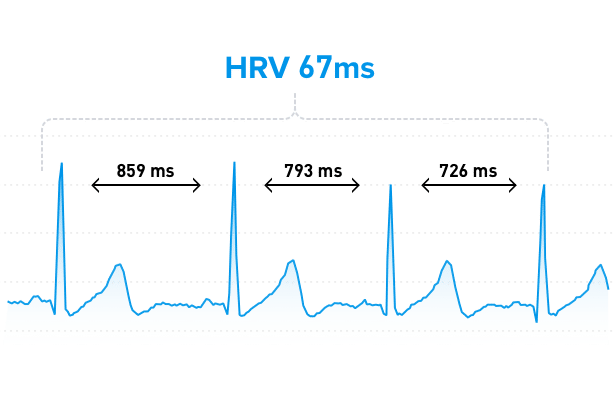
It may not be intuitive, but the more variable your heart activity is beat-to-beat, the less stressed your body typically is. A higher HRV can actually be an indicator that your body is able to adapt effectively and quickly to changes in the environment and to stressful situations.
For the most part, younger people have higher HRV than older people, and males may have slightly higher HRV than females. Elite athletes tend to have greater heart rate variability than non-athletes. This chart shows what the average range in HRV is for different age cohorts.

However, it’s important to understand that HRV is highly variable between people — the average score may differ greatly from one individual to the next. Numerous factors such as age, sex, fitness level, lifestyle, environment and genetics all can have a potential impact. For this reason, it’s better to focus on how your HRV changes over time, rather than your absolute score.
As you use Core, keep an eye on your HRV trends and see whether they trend upwards or downwards. If you’re making efforts to improve your overall health and fitness — including making time for a regular meditation practice — you should see your HRV begin to rise.
Conversely, a downward trend in HRV might be an indicator that your body is under more stress than usual. This could be the result of inadequate sleep, overtraining, poor nutrition, or a taxed immune system. When you see your HRV dropping lower than usual over a couple sessions, it might be a sign that you need to give yourself a little extra care.